Your rating drops overnight, and the next day someone calls offering to make the bad reviews disappear. Here’s the short answer on how to remove a Google review: you can’t delete a genuine bad one, and you shouldn’t pay anyone who says they can. The only route is a report, then an appeal, through Google’s own tools, for reviews that break its policy. Everything else you answer with a calm reply and outweigh with new genuine reviews.
Key takeaways
- Google removes reviews that break its policy, never ones that are just negative.
- Report first, then appeal once with the pattern documented.
- Nobody can sell you a guaranteed removal.
- Australian law limits what you can do yourself.
Decision helper
Can this review come down?
Answer four questions to find the right move.
1Did a demand for money, goods or services come with the reviews?
2Was the reviewer ever a customer? (no booking, invoice or record)
3Is the reviewer a current or former employee, or a competitor?
4Is it off-topic, abusive or harassing?
The right move
General guidance only, not legal advice.
Can you remove Google reviews? Only the ones that break policy
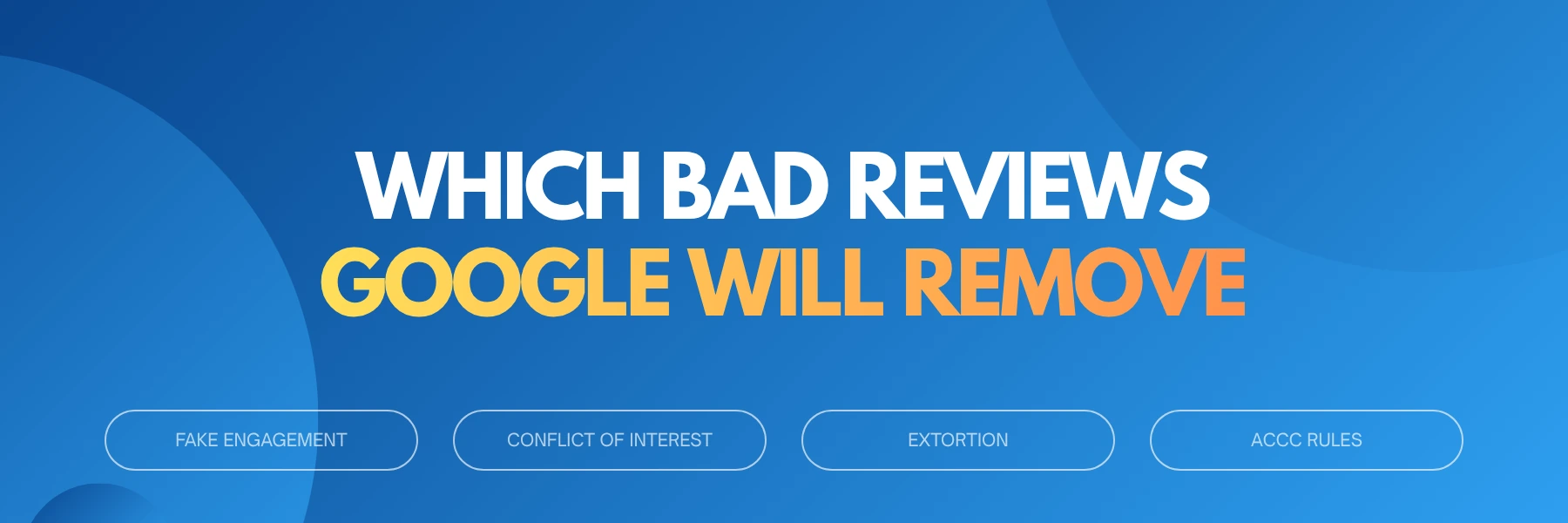
Google removes reviews that break its Maps content policy, not reviews that are simply negative. The categories that matter:
- Fake engagement: no real experience behind it, paid for, or posted from several accounts by one person.
- Conflict of interest: current or former staff, or a competitor.
- Off-topic: rants and commentary unrelated to an experience at your business.
- Harassment: threats or abuse aimed at people or businesses.
Harsh but honest reviews stay. Google is plain about it: “If the review complies with our policies, it will remain live.”
Removal does happen: Google says it blocked or removed over 292 million policy-violating reviews in 2025. It follows the policy, not the star rating.
How to remove a Google review: report, then appeal with evidence
- Report it from your Business Profile, choosing the policy reason that applies.
- Track it in the Reviews Management Tool. Decision pending means nobody has assessed it yet.
- Appeal once, with evidence. If no violation is found, you get a one-time appeal covering up to 10 reviews. Show the pattern: the spike’s dates and times, no booking or invoice matching the reviewer, and a reviewer history that doesn’t fit a customer.
Treat the appeal as the main event. One flag tells Google little. A documented pattern tells it far more.
If the 1-stars come with a demand for money, goods or services, skip the normal report. Use Google’s extortion report form and screenshot every message.
Four reviews, four moves: a hypothetical
Take a hypothetical plumbing business, the sort of trade covered on our SEO for plumbers page. In one week, four reviews land.
Hypothetical review | What it is | The move |
|---|---|---|
A 1-star from a name with no booking, one of six in 48 hours | Fake engagement | Report each as fake engagement, then appeal them together, pattern documented |
A 1-star from a plumber who left the business last month | Conflict of interest | Report it as conflict of interest (former employee) |
A real customer, angry about a late arrival, harsh but accurate | A genuine review | Don’t report. Reply, own the delay, say what changed |
A run of 1-stars, then an email asking for money to stop | Extortion | Extortion form, screenshots, no reply, no payment |
Row three is the hard one: reporting an honest review won’t remove it, but a short, specific reply helps the next customer who reads it.
Why paying for guaranteed removal backfires
Apart from the person who wrote it, nobody but Google can delete Google reviews on your profile. A removal service can only file the reports and appeals you can. Google warns that paying “doesn’t guarantee the removal of reviews” and can encourage further attempts. Treat a cold call offering removal straight after a wave of fake Google reviews with suspicion.
The other side has a fair point. Google’s queue is slow and explains little, and fake 1-stars cost you work while you wait. Owners have also been saying this year that removals feel slower and stricter. Wanting to pay to make it stop is understandable.
Paying someone by the hour to file those reports and appeals is legitimate. You’re paying for their time. What doesn’t hold up is the guarantee, because only Google decides.
When Google says no: the Australian rules
Australian law gives you less room than you might expect, and some of it points back at you. This is general information, not legal advice.
Don’t hide the bad ones yourself. The ACCC says a business may mislead consumers if it removes genuine negative reviews. The Federal Court ordered one online health marketplace to pay $2.9 million in penalties, in a case that included not publishing a large volume of negative reviews and editing others. For a false review, the ACCC’s advice is to ask the platform to remove it, or reply to correct the record.
Ask every customer, not just the happy ones. At least one guide written for Australian businesses suggests singling out happy customers for review requests. Google’s policy settles it: merchants must not “selectively solicit positive reviews from customers”. Ask everyone. If you offer anything in return, the ACCC says it must apply whether the review is positive or negative.
Defamation is narrower than it looks. Under the uniform defamation laws, a company can generally sue only if it has fewer than 10 employees and isn’t an associated entity of another corporation, or if it’s a not-for-profit (Defamation Act 2005 (Qld), s 9, is one example). In Queensland, it must also show the review has caused, or is likely to cause, serious financial loss (s 10A(2)). Check your own state’s Act.
Anonymous reviewer? If you may have a claim but can’t identify the person, rule 7.22 of the Federal Court Rules 2011 lets you seek an order that a third party, such as the platform, help identify them. It’s a court process, with costs.
Don’t threaten honest reviewers. A legal threat over a fair review can end up pasted into an updated review.
The bottom line
Reply well, ask everyone, keep the evidence
You can’t delete a genuine bad review, and nobody can sell you a deleted one. Report and appeal the ones that break policy, with the pattern written down. Reply to the honest ones. Ask every customer, because “More reviews and positive ratings can help your business’s local ranking.” Those local results now feed AI answers too.
Want reviews working for your local rankings?
Reviews are one part of local SEO. See our SEO packages and tell us about your business.
Important FAQs
How do I delete a review I wrote?
- In Google Maps, open Menu.
- Choose Your contributions, then Reviews.
- Click More next to the review.
- Choose Delete review.
Can I switch reviews off during an attack?
Google’s help pages describe no setting for that. In a sudden spam spike, Google says it removes the fake content, pauses new reviews and alerts the owner.
How long does Google take?
Google says review evaluation typically takes several days. Track the status in the Reviews Management Tool.