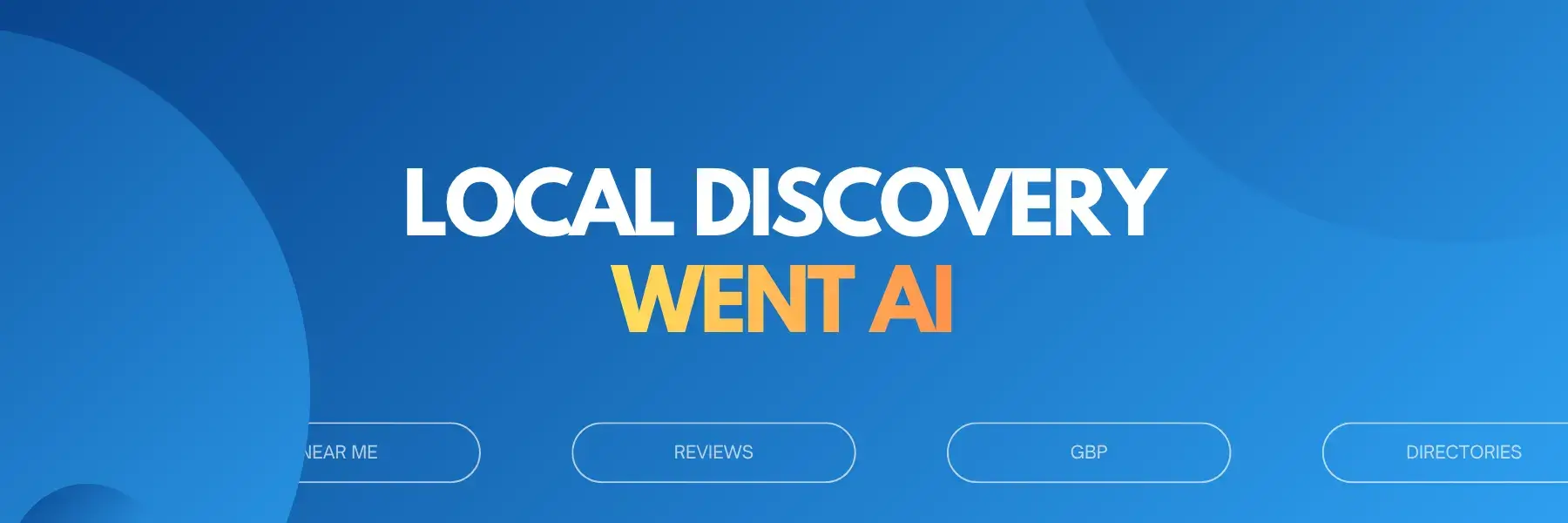
“Near me” searches are up 174 per cent year on year in Australia (DataForSEO, AU keyword data, July 2026). That is 14,800 monthly searches for the exact phrase, plus thousands more in variations like “plumber near me,” “electrician near me” and “dentist near me.” The demand for local discovery is not declining. It is intensifying.
What has changed is where the answer shows up. It used to be the Google local pack: three businesses with a map, some reviews and a phone number. That pack still exists. But increasingly, the answer comes first as an AI-generated recommendation, a block of businesses sorted by review count with addresses, phone numbers and a brief reason for inclusion, before the searcher ever sees the traditional results.
At 21 Webs, we manage local SEO and Google Business Profile optimisation for service businesses across Melbourne and beyond. This article is our analysis of what the shift to AI local answers means for Australian service businesses, what you need to build, and what you can do yourself this week.
The Near Me Finding: Demand Is Up, but the Surface Has Changed
The growth in “near me” searches tells one story. The mechanics of how those searches get answered tell another.
When a user types “plumber near me” into Google in 2026, the result page increasingly includes an AI Overview at the top, a generated summary that names specific businesses, explains why they are relevant and provides contact details. Below that sits the traditional local pack, then organic results, then ads. On ChatGPT and Perplexity, there is no local pack at all. The AI answer is the entire response.
The practical consequence: if your business is not in the AI answer, you are competing for attention below a recommendation the user has already received. That is a fundamentally different competitive position from 2024, when the local pack was the first thing a searcher saw.
Local search demand is not shrinking. It is relocating, and the relocation favours businesses that can be pulled into an AI recommendation. Google itself has confirmed the scale of this shift. AI Overviews now reach over 2 billion monthly users globally across 200+ countries and 40+ languages (blog.google, I/O 2025 and 2026 announcements). AI Mode crossed 1 billion monthly users by May 2026. For local queries specifically, the AI answer is becoming the primary discovery surface, not a supplement to the local pack.
The impact on local service businesses in Melbourne, Sydney, Brisbane and regional Australia is direct. A homeowner searching “emergency plumber near me” at 10pm is not scrolling past an AI recommendation to compare three more options in the local pack. They are calling the business the AI named. If that is not your business, the call goes to your competitor.
BrightLocal’s 2026 Local Consumer Review Survey found that AI tools for local business discovery surged from 6 per cent to 45 per cent in a single year. Google remains the primary channel at 71 per cent, but that figure is down from 83 per cent in 2025. The shift is real, it is measurable, and it is accelerating.
The two numbers sit together deliberately. The demand is surging and the channel is moving. A business that built its local presence around the pack, with proximity and categories optimised, is now discovering that the AI answer applies a different test. Review depth and data consistency are the new filters, and most businesses have not built for them.
The GBP Gap: Most Australian Businesses Are Structurally Invisible
Here is a number that should concern every Australian service business: approximately 56 per cent of Australian local businesses have not claimed their Google Business Profile (industry data, 2026). More than half the market is structurally invisible to AI local answers, because the AI systems that generate local recommendations draw heavily from GBP data, and an unclaimed profile gives the AI nothing reliable to work with.
This is not a complex problem to fix. Claiming your Google Business Profile takes less than 15 minutes. But the fact that more than half of Australian businesses have not done it reveals a gap between how important local visibility has become and how many businesses are actually prepared for it.
If you have not claimed your Google Business Profile, here is what to do right now:
Go to google.com/business and search for your business name.
If a profile already exists (Google auto-generates many), claim it by verifying ownership. Google will typically send a postcard, phone call or email verification.
Complete every field: business name, address, phone number, hours, service categories, service area, website URL, photos and a business description.
Make sure the name, address and phone number (NAP) match exactly what appears on your website and every other directory listing you have.
This is the single highest-return task in local SEO right now. If you are a trades business, healthcare provider, legal practice or any service business that relies on local customers, an unclaimed GBP is the equivalent of an unlisted phone number in the 1990s. It costs nothing to fix and everything to ignore.
If you want help with the full process, our local SEO service includes complete GBP setup, optimisation and ongoing management. But the claim itself is something you can and should do today.
The gap costs multi-location operators most. A single-location business can fix its own profile in an afternoon. A franchise with 40 locations has 40 profiles, each of which may be unclaimed, incomplete or duplicated. That is 40 separate entry points the AI cannot verify, and every one of them is a recommendation the business does not get. The structural problem scales with the business.
The Block Mechanism: How AI Builds the Local Answer
When AI systems generate a local business recommendation, the process looks different from how Google ranks the traditional local pack. Based on our observation across ChatGPT, Perplexity, Gemini and Google AI Overviews, here is what we see:
The AI retrieves business data from multiple sources. Google Business Profile is a primary source, but the AI also pulls from Bing Places, Apple Maps, Foursquare (which supplies approximately 70 per cent of the location data ChatGPT uses for local recommendations, per industry analysis), Yelp, and industry-specific directories.
Review count is the first filter, not the last. The businesses that appear in AI local answers almost always carry significant review volume. Research from 2026 suggests that businesses below roughly 150 reviews per location rarely get named by AI assistants (industry data, 2026). In our experience across Australian service businesses, even 50 to 80 genuine reviews puts you ahead of the majority of competitors who have 5 to 15.
The AI sorts by review count, recency and sentiment, then filters by NAP consistency. A business with 200 reviews and a 4.5 rating that has consistent NAP data across every platform is far more likely to be recommended than a business with 50 reviews and inconsistent information across its profiles.
The output is a structured block. Business name, address, phone number, a brief description and sometimes a direct reason for inclusion (“highest rated in your area,” “most reviewed”). This is not a link to your website. It is a self-contained recommendation.
The block is not an ad. It is not an organic result in the old sense. It is a recommendation delivered before the search results even load, which is why the businesses inside it receive calls the rest never see.
The implication is significant. The traditional local pack ranked you based on proximity, relevance and prominence (which included reviews, but also backlinks, on-page SEO and other factors). The AI local answer is simpler and more brutal: it is essentially a review-count-sorted list filtered by data consistency. If your reviews are thin and your data is inconsistent, you are not in the list. No amount of on-page SEO compensates.
We have seen this play out directly in client campaigns. One plumbing business in Melbourne’s western suburbs went from invisible in AI answers to consistently recommended within 90 days, by implementing a structured review programme and fixing NAP inconsistencies across 40+ directories. The SEO fundamentals mattered. But the review and entity work is what moved the AI recommendation.
Here is how we check which businesses the engines actually name. We run the client’s highest-intent local queries through ChatGPT, Perplexity and Google, then log every business that appears in the block. The pattern holds across industries: the named businesses are almost always the ones with the deepest review profiles and the cleanest data. The ones missing are almost always the ones with neither.
The Source Mix: Where Local Effort Needs to Go Now
For local hiring queries (“best electrician near me,” “dentist Werribee,” “builder western suburbs Melbourne”), AI systems pull from a specific mix of sources. Based on our tracking, the hierarchy looks roughly like this:
Google Business Profile remains the anchor. It is the most complete structured data source for Australian local businesses, and every AI system indexes it.
Review platforms (Google Reviews, Yelp, industry-specific review sites) carry heavy weight because they provide the sentiment and specificity data the AI uses to rank recommendations.
Directories (True Local, Yellow Pages, Clutch for professional services, industry-specific directories) function as entity validators. When the AI sees your business listed consistently across multiple directories, it treats that as a corroboration signal.
Your website matters for content depth. The AI will pull from your service pages, FAQ pages and blog content when generating the descriptive text alongside the recommendation. But the website alone, without the review and directory layer, is not enough to trigger a recommendation.
Forums and social media carry less weight for local hiring queries than for general product or agency queries. This is a difference from the broader AI citation landscape where Reddit is dominant. For “plumber near me” type queries, the AI prefers structured business data over forum discussions.
This is why we warn clients away from copying a national SEO strategy onto a local service business. The source mix that wins a national product query, heavy on Reddit and forums, is not the source mix that wins a “near me” query, heavy on structured business data. The mistake costs months. Knowing which surface you are actually competing on saves them.
Practical DIY checklist for your local discovery stack:
Claim and fully optimise your Google Business Profile (see above).
Claim Bing Places for Business. This takes 10 minutes and is the index behind ChatGPT’s local lookups.
Claim Apple Business Connect. This powers Siri and iPhone-based local lookups.
Ensure your NAP is identical across your website, GBP, Bing Places, Apple Maps and every directory listing.
Add LocalBusiness schema markup to your website. This is structured data that helps AI systems read your business details programmatically. If you are not sure how to do this, our web design team can implement it.
List your business on True Local, Yellow Pages and any industry-specific directories relevant to your trade.
Create or update service-area pages on your website for each suburb or region you serve. These give the AI specific location content to reference.
For a deeper walkthrough of how we structure suburb-specific SEO and local landing pages, see our analysis on how local plumbers boost visibility. The method applies to any local service business, not just plumbing.
The effort split matters as much as the list. In our own local campaigns, the review and data layer takes the largest share of the work, the website’s local content and schema the next, and directory and platform hygiene the rest. The weighting is inverted from the old local playbook, where most of the effort sat on the website and the backlinks.
The Review Velocity Finding: Fresh Reviews Signal an Active Business
This is where we see the biggest gap between what Australian service businesses are doing and what they need to be doing.
BrightLocal’s 2026 data is clear: 97 per cent of consumers read reviews before choosing a local business. 41 per cent now “always” read reviews, up from 29 per cent just one year earlier. And 31 per cent will only use a business rated 4.5 stars or higher.
But the stat that matters most for AI visibility is this: consumers now use an average of six different review platforms when evaluating a local business. And AI systems do the same. They cross-reference reviews across Google, Yelp, Facebook, industry-specific sites and more.
Review velocity, the rate at which you receive new reviews, matters as much as total count. A steady flow of 2 to 4 reviews per week signals an active, trusted business. A profile with 200 reviews that have not been updated in six months signals dormancy. AI systems interpret dormancy as a risk signal, and they prefer to recommend businesses that show consistent recent activity.
Here is a practical review-generation system you can implement this week:
After completing every job, send a follow-up text or email with a direct link to your Google review page. Make it one tap. Do not make the customer search for where to leave a review.
Time it right. Within 2 to 4 hours of job completion is the sweet spot. The experience is fresh and the customer is most likely to follow through.
Respond to every review, positive and negative, within 48 hours. AI systems can see your response rate, and it factors into the trust signal.
Never offer incentives for reviews. This violates Google’s guidelines and can result in profile suspension. Ask genuinely. Most satisfied customers will leave a review if the process is easy.
Aim for consistency, not bursts. 3 to 4 reviews per week is better than 20 in one week and then nothing for two months.
The underlying logic is the same for the AI as it is for a customer. A business that collects reviews steadily looks alive. A business that collects them in bursts, or stops collecting them, looks erratic. The AI does not need to be told which is which. The pattern is visible in the data it pulls.
If you manage multiple locations or want a more systematic approach, our local SEO service includes structured review-generation programmes tailored to your industry and customer workflow. We also cover this ground for specific trades in our guides for home builder SEO and removalist SEO.
The Entity Finding: NAP Consistency Is the Trust Layer
NAP stands for Name, Address, Phone number. It sounds basic. It is basic. And it is the most common failure point we see in local SEO audits.
AI systems cross-reference your business information across every source they can find. If your Google Business Profile says “21 Web Solutions Pty Ltd” but your website says “21 Webs” and your Yelp listing says “21Webs Digital,” the AI sees three potentially different businesses. It does not guess. It downgrades confidence and may exclude you from the recommendation entirely.
Your NAP audit in five steps:
Pick one canonical version of your business name, address and phone number. Usually, this is what appears on your Google Business Profile.
Search for your business name across Google, Bing, Apple Maps, Yelp, True Local, Yellow Pages, Facebook, LinkedIn and any industry directories.
Fix every inconsistency. Character for character. “Suite 3, 45 Smith St” is not the same as “3/45 Smith Street” to an AI system.
If you have changed address or phone number in the past, search for old listings that still show the previous details. These create confusion and reduce your trust score.
Set a calendar reminder to audit NAP consistency every quarter. Directory listings can revert or be overwritten by data aggregators.
This is tedious work. It is also one of the highest-leverage tasks in local SEO for AI visibility. If you want to outsource it, our local SEO service includes full NAP audit and citation management across 40+ directories.
The Implication: Who the New Local Discovery Stack Excludes
The new local discovery stack is not complicated. It is:
A claimed, fully optimised Google Business Profile.
Consistent NAP data across every directory and platform.
A steady flow of genuine, recent reviews with specific service details.
LocalBusiness schema markup on your website.
Service-area pages and FAQ content that the AI can reference.
Presence on Bing Places, Apple Maps and industry-specific directories.
Businesses that have all six elements are in the pool from which AI makes recommendations. Businesses missing any of them are structurally excluded.
The businesses most at risk are the ones that have relied on word-of-mouth and repeat customers without building a digital presence. In Australia, that describes a significant portion of trades businesses, healthcare practices and professional services firms. They are excellent at what they do. They are invisible to the channel where their next customers are increasingly looking.
We built our industry-specific SEO practice around closing this gap for trades, healthcare, legal and property businesses. And our broader AI SEO services address the full stack, from traditional ranking through to AI citation and local recommendation.
If you are not sure where your business stands right now, here is a quick self-test:
Open ChatGPT. Type your most important “near me” query. Is your business named?
Open Google. Search the same query. Do you appear in the AI Overview at the top, the local pack, or both?
Open Perplexity. Run the same query. Are you mentioned?
If the answer to all three is no, you have a local discovery gap. The good news: the fix is structural, not expensive. It starts with the GBP claim, the NAP audit and the review programme described above. Those three actions alone will put you ahead of the 56 per cent of Australian businesses that have not even started.
Nothing in this list is expensive. The GBP claim is free. The NAP audit is an afternoon. The review programme is a follow-up text after every job. What separates the businesses that fix this from the ones that do not is not budget. It is deciding that AI local answers are where their next customers are, and then acting on it.
For a broader perspective on how AI search changes SEO strategy beyond local, read our analysis on what AI search actually means for SEO in 2026. And for context on why Reddit threads also matter for broader service queries (though less so for “near me” local queries), see our analysis on why Reddit is ranking everywhere on Google in 2026.
Important FAQs
Why am I not showing up in AI local answers?
The most common reasons are: an unclaimed or incomplete Google Business Profile, too few reviews (under 50 in most industries), inconsistent NAP data across directories, and missing structured data (schema markup) on your website. Start by claiming your GBP and running a NAP consistency audit.
Do reviews affect ChatGPT and AI search?
Yes. ChatGPT references reviews in approximately 58 per cent of its local responses, and Perplexity uses reviews in 100 per cent (industry data, 2025-2026). Review count, recency, sentiment and specificity all factor into whether the AI recommends your business. A steady flow of 2 to 4 reviews per week is more valuable than a one-off burst.
What is the new local discovery stack?
It is the combination of signals AI systems use to generate local business recommendations: a claimed Google Business Profile, consistent NAP across directories, review volume and velocity, LocalBusiness schema markup, service-area content on your website, and presence on Bing Places and Apple Maps.
Is the Google local pack dead?
No. The local pack still appears on most local queries and still drives calls and directions. But it is no longer the first thing many searchers see. AI Overviews and AI Mode increasingly answer the query before the user reaches the local pack. The pack is alive, but it is no longer the top of the funnel for a growing share of searches.
The Bottom Line
If that is not your business, the call goes to your competitor.
The new local discovery stack is not complicated: a claimed, fully optimised Google Business Profile, consistent NAP data, a steady flow of recent reviews, LocalBusiness schema markup, service-area content and presence on Bing Places and Apple Maps. Businesses missing any of them are structurally excluded from the pool from which AI makes recommendations. The fix is not expensive. It starts with the GBP claim, the NAP audit and the review programme. Those three actions alone will put you ahead of the 56 per cent of Australian businesses that have not even started.
Want to know whether AI actually names your business?
We run your highest-intent local queries through ChatGPT, Perplexity and Google and log every business that appears in the block. If yours is not there, the review and entity work is the gap. Talk to our team about your local discovery stack, or get in touch to start with the GBP claim, the NAP audit and the review programme.
Sources
[1] BrightLocal, “Local Consumer Review Survey 2026”. https://www.brightlocal.com/research/local-consumer-review-survey/
[2] Google (blog.google), I/O 2025 and 2026 announcements: AI Overviews reach over 2 billion monthly users globally; AI Mode crossed 1 billion monthly users by May 2026. https://blog.google/
[3] Google Business Profile (google.com/business). https://www.google.com/business/