The best time to post on Instagram in Australia, going by Sprout Social’s study of more than 68 million Australian brand engagements, is 5 to 10 pm, Monday to Thursday. That’s a fair starting point with two catches. It’s an average across other brands’ accounts, not yours. And the study lists every time in AEST, a clock Sydney and Melbourne aren’t on from October to April. Below is what those windows mean in all eight capitals, one schedule that reaches both coasts, and how to find your own best times in Instagram Insights.
Instagram posting time converter
Pick where your customers are and which clock you schedule on. You get each day's posting windows on your own clock.
Key takeaways
- Sprout Social’s Australian data puts the best Instagram windows at 5 to 10 pm, Monday to Thursday, with Saturday the weakest day.
- Its times are labelled AEST, but Sydney, Melbourne, Canberra, Hobart and Adelaide move to daylight saving from 4 October 2026 to 4 April 2027.
- Read the windows as your customers’ local evening. The real errors happen when the person scheduling sits on a different clock.
- On most weekday evenings, one post can reach both coasts: 8 to 10 pm Sydney time in summer, 7 to 10 pm in winter.
- Your own Insights beat any national chart. Run a four-week test.
What is the best time to post on Instagram in Australia?
Here’s the Instagram table from Sprout Social’s Australian study, first published in March 2026. It’s built on more than 68 million Australia-specific brand engagements across six networks, and the windows below are its Instagram results.
Day | Best times to post (as published, AEST) |
|---|---|
Monday | 5 to 10 pm |
Tuesday | 6 to 10 pm |
Wednesday | 5 to 10 pm |
Thursday | 5 to 10 pm |
Friday | 8 to 10 am, 6 to 7 pm, 8 to 9 pm |
Saturday | 9 to 11 am, 6 to 10 pm |
Sunday | 8 to 9 pm |
Instagram windows from Sprout Social’s Australian study, times as published (AEST).
Sprout names Monday and Thursday as the best days for Instagram and Saturday as the worst. It puts the weekday evening block down to second-screening, people scrolling while they watch TV.
A gym’s followers and an accountant’s followers don’t keep the same hours, so treat the table as a first guess you’ll replace with your own data. Facebook, for comparison, runs earlier in the same study: weekdays from 4 to 9 pm AEST. If you run both, don’t copy one schedule across; our Facebook marketing page covers that channel.
Does daylight saving change the best time to post?
The habit stays the same; the clock moves. Sprout’s page says “All times are listed in Australian Eastern Standard Time (AEST)”. Sydney only runs on AEST outside daylight saving.
According to the NSW Government, New South Wales, Victoria, South Australia, Tasmania and the ACT observe daylight saving, and Queensland, Western Australia and the Northern Territory don’t. This season runs from Sunday 4 October 2026 to Sunday 4 April 2027.
Read literally, 5 to 10 pm AEST is 6 to 11 pm on a Sydney or Melbourne clock in summer. That’s not the useful reading. The evening block describes a routine, dinner done and the TV on, and routines follow the local clock. So treat the windows as your customers’ local evening in every season.
Daylight saving bites when the person scheduling and the customers are on different clocks, because that gap moves twice a year.
What time is it in each capital when you post?
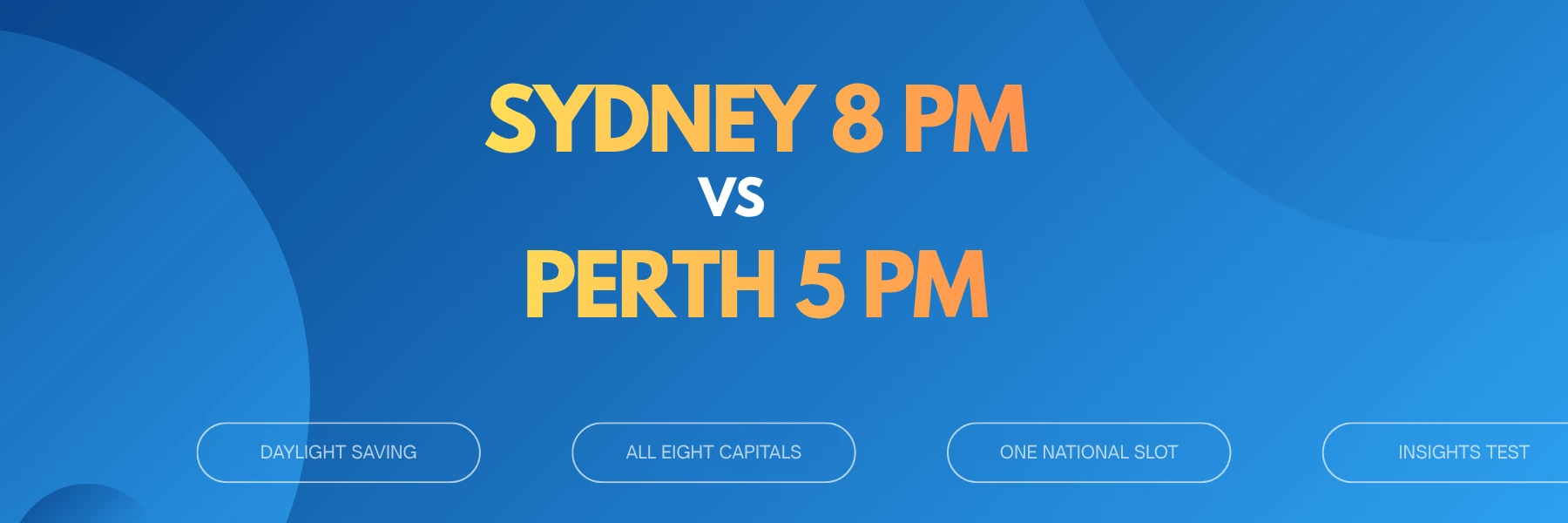
One post, eight clocks. If you publish at 8 pm Sydney time, here’s when it lands.
Capital | Summer (4 Oct 2026 to 4 Apr 2027) | Winter |
|---|---|---|
Sydney | 8:00 pm | 8:00 pm |
Melbourne | 8:00 pm | 8:00 pm |
Canberra | 8:00 pm | 8:00 pm |
Hobart | 8:00 pm | 8:00 pm |
Adelaide | 7:30 pm | 7:30 pm |
Brisbane | 7:00 pm | 8:00 pm |
Darwin | 6:30 pm | 7:30 pm |
Perth | 5:00 pm | 6:00 pm |
Adelaide stays 30 minutes behind Sydney all year, because South Australia shifts on the same dates. Brisbane and Darwin lose an extra hour on Sydney in summer. Perth is two hours behind in winter and three in summer.
How do you schedule for Perth, Brisbane or Darwin from a Sydney clock?
If your customers are in another city and you schedule on Sydney or Melbourne time, here’s their Monday, Wednesday and Thursday evening window (5 to 10 pm local) on your clock. Tuesday starts an hour later.
Customers in | Summer, on a Sydney clock | Winter, on a Sydney clock |
|---|---|---|
Sydney, Melbourne, Canberra, Hobart | 5 to 10 pm | 5 to 10 pm |
Adelaide | 5:30 to 10:30 pm | 5:30 to 10:30 pm |
Brisbane | 6 to 11 pm | 5 to 10 pm |
Darwin | 6:30 to 11:30 pm | 5:30 to 10:30 pm |
Perth | 8 pm to 1 am | 7 pm to midnight |
A hypothetical example. Take a hypothetical Perth cafe whose posts are handled by a freelancer in Melbourne. In November she schedules the Thursday dinner special for 6 pm on her clock. That’s 3 pm in Perth. To land at 6 pm Perth time she needs 9 pm Melbourne time, and 8 pm once daylight saving ends in April.
The fix takes four steps:
- Write down where your customers are, not where your business or your marketer is.
- Check which clock your scheduler uses. If your tool lets you set a time zone, set it to your customers’ city.
- Convert once with the table above (or the converter at the top) and save the times in your content calendar.
- Put two reminders in your calendar, for the first Sunday in October and the first Sunday in April, when the gap moves.
Is there one time that works for all of Australia?
Yes, on most weekday evenings. If you treat Monday, Wednesday and Thursday’s 5 to 10 pm as the window in every capital, the slot that sits inside it everywhere at once is:
- Summer: 8 to 10 pm Sydney time. That’s 7:30 to 9:30 pm in Adelaide, 7 to 9 pm in Brisbane, 6:30 to 8:30 pm in Darwin and 5 to 7 pm in Perth.
- Winter: 7 to 10 pm Sydney time. That’s 6:30 to 9:30 pm in Adelaide and Darwin, 7 to 10 pm in Brisbane and 5 to 8 pm in Perth.
Tuesday’s window opens at 6 pm, which trims it to 9 to 10 pm Sydney time in summer and 8 to 10 pm in winter. All of this assumes Perth scrolls in its own evening the way the east coast does. That’s our reading of the data, not something the study measured on its own.
Weekends are harder. Saturday’s 6 to 10 pm window overlaps like Tuesday’s, but Friday’s one-hour evening slots and Sunday’s 8 to 9 pm slot don’t line up across both coasts. If one city brings most of your customers, post for that city.
How do you find your own best time in Instagram Insights?
Charts describe other people’s followers; Instagram will show you yours. You need a public account, personal or professional. On a computer, Instagram’s help pages give this route:
- On instagram.com, select Dashboard from the left-hand menu.
- With a professional account, select Insights below For professionals. With a personal account, select Your dashboard below Your insights and tools.
- From the Insights dropdown, select Account.
- Choose the last 7, 14, 30 or 90 days, or a custom range within the past 90 days.
- In your follower insights, find “Times they’re most active on Instagram”.
Two limits to know. Audience details need a preset timeframe and more than 100 accounts reached or engaged, so a new account may see nothing yet. And the help pages we checked don’t say which time zone that chart uses, so sanity-check it against hours you already know, like when your bookings or enquiries usually come in.
Run a four-week posting test
The active-times chart shows when followers are on the app, not which time gets your posts the most attention. A simple test answers that.
- Pick two slots. One from the table above, one from your Insights peak. For example, 6 pm and 9 pm in your customers’ city.
- Alternate them for four weeks. Same kind of post, same days, only the time changes.
- Log each post a few days after it goes up. Record views, interactions and accounts engaged from the post’s insights.
- Compare the typical post, not the best one. One viral post at 9 pm doesn’t make 9 pm your slot.
- Keep the winner, then retest after each daylight saving change if your customers span more than one time zone.
A plain log is enough:
Date | Slot | Post type | Views | Interactions | Accounts engaged |
|---|---|---|---|---|---|
To see whether Instagram visits become enquiries, pair the test with the GA4 reports worth checking every month.
Once you know your slot, Instagram’s own scheduler can post for you. Instagram says you can schedule up to 25 posts a day, up to 30 days ahead, from a public account. Tap Create, choose Post or Reel, add your caption, tap More options, turn on Schedule this post (or Schedule this reel), pick the date and time, then tap Done, Back and Schedule.
Does posting time really matter that much?
Many marketers say it barely does, and they have a fair point. Their argument is that a strong post keeps travelling well after the first hour, and a weak post at the perfect time is still a weak post. Content and consistency carry more weight than the clock.
Where timing does cost you is the time zone mistake. A dinner special that lands in Perth at 3 pm, or a Brisbane post timed on a Sydney clock in summer and an hour early, is an easy loss to avoid. Weighing paid social against search? See our Google Ads vs social media ads for cleaning companies comparison.
The bottom line
Post on your customers' clock, then let your data decide
The best time to post on Instagram in Australia starts at 5 to 10 pm, Monday to Thursday, read as your customers’ local time. Convert it whenever you schedule from another city, reset it on the first Sundays of October and April, and on most weekday evenings use 8 to 10 pm Sydney time in summer (7 to 10 pm in winter) when one post has to reach both coasts. Then run your own four-week test and trust that over any chart.
Want an Instagram calendar built around your customers?
See how our Instagram marketing Australia service plans content for Australian businesses.
Important FAQs
What is the best time to post on Instagram in Australia?
Sprout Social’s Australian study puts it at 5 to 10 pm, Monday to Thursday, with Monday and Thursday the strongest days and Saturday the weakest. Read those windows as your customers’ local evening, then check your own Instagram Insights, because any national chart is an average of other brands’ audiences.
Do I need to change my posting times for daylight saving?
Not if you post on your customers’ local clock. You do need to adjust when you schedule from a different time zone. From 4 October 2026 to 4 April 2027, Brisbane and Darwin sit an extra hour behind Sydney, and Perth moves from two hours behind to three.
What is the best time to post on Instagram in Perth?
Use the same evening window on Perth’s own clock: 5 to 10 pm on Monday, Wednesday and Thursday, and 6 to 10 pm on Tuesday. If you schedule on Sydney or Melbourne time, that’s 8 pm to 1 am in summer and 7 pm to midnight in winter. Then confirm it against your own follower insights.
How do I see when my Instagram followers are online?
Open your Instagram insights, choose Account, and look in your follower insights for the times they’re most active on Instagram. You need a public account, and audience details only appear once you’ve reached or engaged more than 100 accounts in a preset timeframe.