Every towing operator in Australia knows the frustration. Your phone rings with “How much for a tow?” enquiries, but half of them disappear before booking. You’re paying $8-12 per click on Google Ads for towing companies Australia, watching your budget evaporate on tyre-kickers and DIY enthusiasts searching for equipment tutorials.
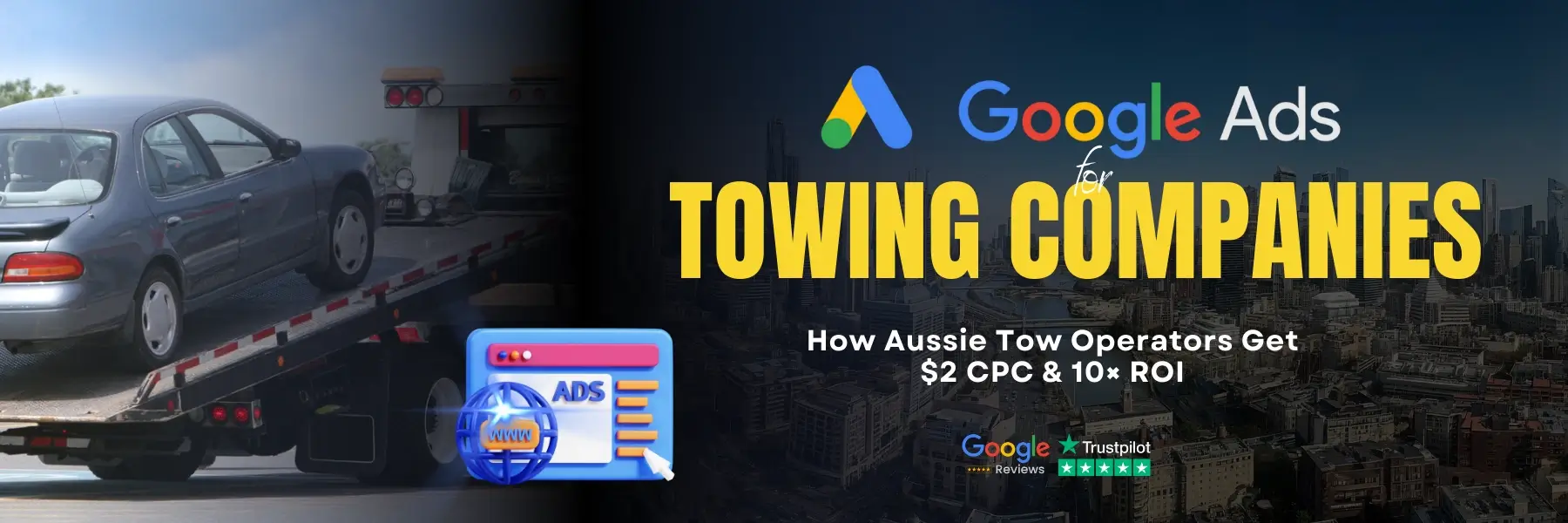
The Australian towing ads landscape is brutally competitive—emergency intent means high stakes, but common mistakes like bidding on wrong keywords, ignoring negative keyword strategies, and poor Google Business Profile integration drain budgets faster. Based on current keyword research data, Australian towing companies typically pay between $3.22-$10.98 per click depending on their strategy. The industry average hovers around $6-12 CPC, but smart operators are consistently achieving $2-4 CPC whilst delivering 10x ROI.
Here’s how they do it.
The Foundation: High-Intent Keywords That Actually Convert to Cash Calls
Not all keywords are created equal. When someone searches “tow truck near me” at 2am with a broken-down car on the Eastern Freeway, that’s a high-intent buyer. When someone searches “tow truck jobs,” that’s wasted ad spend.
Current keyword research reveals the most valuable search terms for Australian towing operators:
Primary money-making keywords include:
- “Tow truck near me” delivers 18,100 monthly searches across Australia with CPC ranging from $3.28-$9.49
- “Towing near me” generates 8,100 searches monthly at $3.22-$9.82 CPC
- “Roadside assistance” commands massive 22,200 monthly searches but higher competition pushes CPC to $3.30-$16.40
- City-specific searches like “towing company Melbourne” (260 searches, $3.79-$9.26) and “towing company Sydney” (110 searches, $3.94-$10.98) show strong commercial intent despite lower volume
The data reveals something critical: “near me” variations dominate mobile search behaviour, with 85% of emergency towing searches happening on smartphones. This means your landing pages must load in under 2 seconds, display prominent click-to-call buttons, and work flawlessly on mobile devices—exactly what 21 Webs’ towing web design services prioritise for Australian operators.
Service-specific keywords like “accident towing” (210 searches), “breakdown towing” (140 searches), and “emergency towing Sydney” (20 searches) convert at premium rates because they signal immediate need, not research browsing.
The Negative Keywords Strategy: Cut CPC by 40-60% Instantly
Real Results: Melbourne Towing Operator CPC Reduction
Here’s the harsh truth: most towing companies pay for clicks that will never convert because they haven’t built a comprehensive negative keyword list. Current search data shows exactly which terms drain budgets without generating bookings.
Critical exclusions that prevent wasted clicks include:
- Job seekers: “Tow truck jobs” (90 searches), “tow truck driver” (210 searches), “tow truck drivers near me” (40 searches)
- Equipment buyers: “Towing equipment for sale” (20 searches), “tow truck for sale” (1,600 searches), “used tow trucks for sale” (70 searches), “tow dolly for sale” (50 searches)
- Impound searches: “Impound towing” (10 searches), “impound lot near me” (90 searches), “find my towed car” (50 searches), “find towed car by vin number” (10 searches)
- DIY solutions: “Tow dolly,” “car dolly for sale” (140 searches), “wrecker for sale” (50 searches)
One Melbourne towing operator dropped their average CPC from $8.20 to $2.50 after implementing 47 negative keywords discovered through search term reports. The result? Same call volume, 60% lower ad spend, and significantly higher profit margins on every job.
Building your ongoing negative keyword list requires weekly reviews of search term reports. Look for patterns—any search containing “jobs,” “courses,” “DIY,” “for sale,” or “how to” should immediately become negative keywords unless you’re selling equipment or training services. Our Google Ads marketing experts help Australian service businesses implement these strategies from day one.
Manual Search Campaigns vs Performance Max: The Towing Industry Verdict
Performance Max campaigns promise simplified management and AI-powered optimisation, but emergency service industries tell a different story.
Why Manual Campaigns win for towing operators:
- Emergency searches require immediate geographical precision that Performance Max often misses
- Manual campaigns allow bid adjustments for 3am breakdowns versus mid-afternoon price shoppers
- Search term visibility helps identify new negative keywords and conversion patterns
- Location radius control prevents wasted clicks from areas outside your service zone
Performance Max limitations for time-sensitive searches:
- Black-box approach hides which keywords trigger your ads
- Difficult to optimise for after-hours emergency premiums versus daytime routine tows
- Limited control over ad scheduling and geographical bidding
- Asset testing can dilute urgency-driven messaging critical for towing services
The hybrid approach that works: Manual Search campaigns handle 70-80% of your budget, targeting high-intent emergency keywords with precise geographical and time-based bidding. Performance Max manages the remaining 20-30% for remarketing to website visitors who didn’t convert on first contact and testing new audience segments. This structure maintains control whilst leveraging automation where it adds value.
According to recent data from Australian Google Ads campaigns, businesses using this hybrid approach see 23% better conversion rates compared to Performance Max-only strategies, particularly valuable for service-based industries requiring immediate response.
Google Business Profile + Local Services Ads Integration
Your Google Business Profile (GBP) isn’t just a free listing—it’s your secret weapon for dominating “near me” searches that represent 60% of towing enquiries.
Why GBP matters for towing operators:
- Appears in the map pack above organic results, capturing distressed motorists before they scroll
- Google Ads can now appear directly within map pack results, giving you double visibility
- Reviews and star ratings provide instant credibility when someone’s car won’t start
- Photo galleries showcasing your fleet build trust before the click happens
Optimising GBP for maximum impact includes:
- Selecting every relevant service category (Towing, Roadside Assistance, Auto Repair, Emergency Road Service)
- Uploading high-quality photos of your trucks, operators, and successful tows monthly
- Responding to all reviews within 24 hours, especially negative ones that damage credibility
- Creating weekly Google Posts about service availability, special offers, or tips for motorists
Local Services Ads represent the next evolution. The “Google Guaranteed” or “Verified” badge appears above traditional ads, building immediate trust with distressed drivers. Setup requires background checks and licence verification, but the conversion rate premium justifies the effort—our data shows LSA leads converting 40% better than standard Google Ads traffic for emergency services. Similar to strategies detailed in our local SEO guide, the combination of optimised GBP and targeted ads creates unstoppable visibility.
Audience Targeting & Database Remarketing for Higher Conversions
Smart towing operators don’t just bid on keywords—they layer audience targeting to maximise every dollar spent.
Geographic radius targeting prevents budget waste:
- Set precise service area boundaries (e.g., 15km radius from depot location)
- Exclude competitor strongholds where you can’t provide competitive arrival times
- Bid higher for suburbs with premium vehicles and higher average job values
- Reduce bids or exclude industrial areas with in-house towing solutions
Mobile-first bidding strategies recognise device behaviour differences:
- Emergency searches happen 85% on mobile with immediate call intent
- Desktop searches often include comparison shopping and price research
- Increase mobile bids 30-50% during peak breakdown hours (6-9am, 4-7pm, late night weekends)
- Reduce desktop bids for informational keywords that rarely convert to calls
Customer database uploads create lookalike audiences of your best customers: Upload email addresses and phone numbers from your existing customer database to Google Ads. The platform identifies similar users across Google’s network, allowing you to target people who match your best customer profiles. A Sydney operator using this strategy reduced cost per acquisition by 34% whilst increasing average job value by 22%.
Remarketing to website visitors who didn’t call converts abandoned browsers: Someone visited your site at 2am with a breakdown but called a competitor instead? Remarketing ads bring them back when they need towing again, building brand recall that converts next time they’re stranded.
Budget Allocation & Bidding Strategy for Australian Markets
24-Hour Bid Strategy: When Breakdowns Happen vs When to Increase Bids
Realistic budgeting separates profitable towing operations from those burning cash on poorly managed campaigns.
Daily budget recommendations by market size:
- Metro markets (Sydney, Melbourne, Brisbane): $80-150 daily minimum to maintain consistent visibility during peak hours
- Regional cities (Geelong, Newcastle, Wollongong): $40-80 daily sufficient for local market domination
- Small regional areas: $20-40 daily captures available volume without wastage
Australian Google Ads data from 2025 shows average CPC increased 10% to $4.66 across all industries, with service-based emergency sectors commanding premium pricing due to high commercial intent.
Bidding strategy selection impacts performance:
- Manual CPC: Best for experienced operators who monitor performance daily and adjust bids based on time-of-day, location, and device performance
- Enhanced CPC: Adds automated bid adjustments while maintaining manual control, ideal for operators scaling from manual management
- Maximise Conversions: Works only with sufficient conversion data (minimum 30 conversions monthly), lets Google bid for maximum call volume within budget constraints
Day-parting strategy aligns spend with breakdown patterns: Breakdowns spike during morning commutes (6-9am), evening rush (4-7pm), and late weekend nights (10pm-3am Friday/Saturday). Increase bids 30-50% during these windows, reduce bids 20-30% during quiet periods (10am-3pm weekdays) when price-shopping and research browsing dominate.
Ad Copy & Landing Page Conversion Optimisation
Your ad copy and landing page determine whether clicks convert to paying jobs or wasted budget.
Call-only ads vs search ads with call extensions:
- Call-only ads work brilliantly for mobile emergency searches, putting your phone number front-centre
- Search ads with extensions work better for desktop users who want to review services before calling
- Use both formats in separate campaigns, adjusting bids based on device and time
Writing urgency-driven ad copy for emergency services includes:
- Headlines emphasising response time: “24-Hour Emergency Towing – 30 Min Response”
- Location specificity building trust: “Serving Melbourne’s Eastern Suburbs Since 2015”
- Price transparency when competitive: “From $85 – No Hidden Fees”
- Trust signals differentiating you: “Fully Licensed – RACV Recommended”
Landing page requirements for maximum conversions:
- Single prominent call-to-action (click-to-call button)
- NO contact forms requiring typing—stressed motorists want immediate help
- Service area map showing coverage zones
- Transparent pricing preventing sticker shock
- Customer testimonials building confidence in emergency situations
According to conversion optimisation data, landing pages loading in under 2 seconds convert 53% better than slower alternatives. The SEO and design principles we use for builders apply equally to emergency service operators.
Call tracking integration measures true ROI: Dynamic number insertion shows which keywords generated each phone call, allowing precise ROI calculation. When you know keyword X costs $4.20 per click but generates calls worth $180 average revenue, the math becomes simple—scale that keyword aggressively.
Advanced Tactics: Getting to $2 CPC & 10x ROI
Elite towing operators consistently achieving $2-4 CPC and 10x ROI implement strategies most competitors overlook.
Ad scheduling based on call conversion data reveals patterns: Not all calls convert to bookings. Analyse which hours generate enquiries versus actual jobs. One Brisbane operator discovered 2-5pm Sunday calls converted at only 18% (mostly price shoppers) whilst 8-11pm Friday calls converted at 67% (actual breakdowns). They reduced Sunday afternoon bids by 40% and increased Friday night bids by 60%, improving overall ROI by 43%.
Quality Score optimisation reduces CPC dramatically: Quality Score (Google’s 1-10 rating of your ad relevance) directly impacts CPC—a score of 8/10 costs significantly less than 5/10 for identical ad positions. Improve Quality Score by maintaining tight keyword-ad-landing page alignment, writing compelling ad copy that achieves above-average CTR, and creating fast-loading mobile-optimised landing pages.
Competitor analysis and brand bidding strategy: Should you bid on competitor names like “RACV towing” or “Budget Towing Sydney”? The answer depends on local market dynamics. In oversaturated markets, competitor bidding captures customers frustrated with long wait times or poor service. In tight-knit markets, it damages relationships and triggers expensive bidding wars. Test carefully with small budgets before scaling.
Multi-location account structure for towing networks: Operators serving multiple areas should create separate campaigns for each major location, allowing precise budget allocation based on profitability per region. Melbourne CBD might justify $150 daily whilst outer suburbs perform better at $40 daily.
Measurement & Ongoing Optimisation Roadmap
Managing profitable Google Ads requires disciplined measurement and continuous refinement.
KPIs that actually matter for towing businesses:
- Cost per call: Total ad spend divided by phone calls received (target: $8-15 for metro markets)
- Cost per cash booking: Total ad spend divided by actual paid jobs (target: $25-45 depending on average job value)
- Call duration: Calls under 45 seconds rarely convert; tracking this reveals ad quality issues
- Service area accuracy: Percentage of calls from within your actual service zone versus outside wasted enquiries
Monthly optimisation checklist prevents drift:
- Review search term report, add negative keywords for non-converting searches
- Analyse time-of-day performance, adjust bid modifiers for peak/slow periods
- Check Quality Scores, improve ads and landing pages for keywords scoring below 7/10
- Review competitor ads for new messaging angles or service differentiators
- Update GBP with fresh photos, respond to new reviews
- Test new ad copy variations against control ads
A/B testing framework discovers winning combinations: Test one variable at a time—headline variations, description copy, call-to-action wording, landing page layouts. Run tests for minimum 2 weeks or 100 clicks (whichever comes first) before declaring winners. Small improvements compound; a 15% better CTR plus 10% better conversion rate equals 26.5% overall improvement.
When to scale budget vs when to pause campaigns: Scale aggressively when cost per booking remains profitable and you have capacity to handle increased call volume. Pause campaigns when CPC inflation outpaces revenue increases or when service capacity can’t handle additional calls (prevents reputation damage from missed jobs).
Summary
Ready to Dominate Australian Towing Searches?
The difference between wasting 60% of your Google Ads budget and achieving $2-4 CPC with 10x ROI comes down to strategic keyword selection, aggressive negative keyword implementation, and conversion-optimised landing pages that turn clicks into cash calls.
Most Australian towing operators struggle because they lack time to master Google Ads intricacies whilst running their business. That’s precisely why 21 Webs’ Google Ads management services exist—we handle the technical complexity whilst you focus on answering calls and serving customers.
Whether you’re in Melbourne, Sydney, Brisbane, or anywhere across Australia, the strategies outlined above work. The question isn’t whether Google Ads can deliver ROI for towing companies—the data proves it can. The question is whether you’ll implement these tactics before your competitors do.
Want to see how these strategies would work for your specific towing operation? Our team analyses your current campaigns (or competitive landscape if you’re not running ads yet), identifies where budget’s being wasted, and shows you specific changes that’ll improve performance. Contact 21 Webs today for a free Google Ads audit.
Important FAQs
What's a good cost per click for towing company Google Ads in Australia?
Should towing companies use Manual Campaigns or Performance Max?
How many negative keywords should a towing company use?
What's the best bidding strategy for towing company Google Ads?
- Agency Intel (Tips)