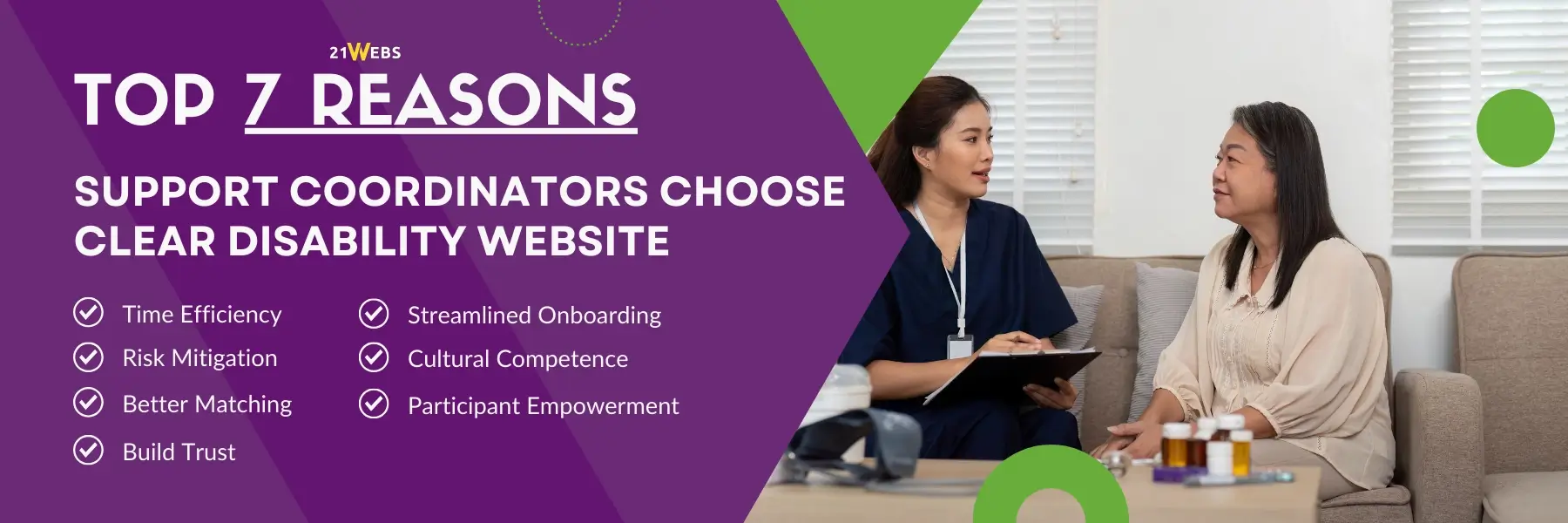

Why your online presence determines whether support coordinators recommend you
A typical support coordinator in Melbourne receives fifteen provider recommendations daily from participants, families, and professional networks. Within five minutes of reviewing online presence, they’ve shortlisted three providers for serious consideration. The rest? Dismissed—not necessarily because they lack quality services, but because they failed to communicate their value clearly online.
What separates the shortlisted providers from the overlooked? A professional digital presence anchored by comprehensive capability statements and transparent service pages. In Australia’s evolving NDIS landscape, where the 2024 reforms emphasise greater participant control over provider selection through new digital comparison tools, your website has become the primary vetting tool for support coordinators responsible for matching hundreds of participants with appropriate services.
For NDIS providers across Sydney, Melbourne, and Brisbane, understanding why support coordinators prioritise clear online documentation isn’t just about better marketing—it’s about demonstrating the professionalism and transparency that underpins safe, effective participant outcomes.
1. Time Efficiency in Provider Vetting
Support coordinators juggle complex caseloads whilst managing tight timeframes. When a participant needs immediate support—whether that’s specialist behaviour support, psychosocial disability services, or mobility assistance—coordinators cannot afford to spend hours chasing basic provider information through phone calls and email exchanges.
A well-structured capability statement allows coordinators to assess provider qualifications, experience levels, and service scope within minutes. This documentation should clearly outline NDIS registration details, staff qualifications, years of operation, and specific service delivery models. Providers who present this information transparently in dedicated service pages immediately signal professionalism and respect for coordinators’ time constraints.
The 2024 NDIS reforms introduced stricter provider verification requirements, with support coordinators now expected to verify registration class, practice standards alignment, and complaints history. Websites that streamline this verification process through accessible documentation significantly reduce coordination burden whilst accelerating participant onboarding.

2. Risk Mitigation & Due Diligence
Support coordinators carry substantial professional responsibility for participant safety and quality outcomes. Under the NDIS Code of Conduct, coordinators must demonstrate due diligence in provider recommendations—a requirement that extends far beyond simply matching services to participant needs.
Transparent online documentation helps coordinators fulfil their safeguarding obligations. Detailed capability statements should address:
- NDIS Practice Standards compliance across relevant modules
- Worker screening verification processes
- Incident management and complaints handling procedures
- Quality assurance frameworks and continuous improvement systems
- Insurance coverage and professional indemnity details
When providers make this information readily accessible, support coordinators can confidently recommend services knowing they’ve conducted appropriate risk assessments. Conversely, providers with vague service descriptions or missing compliance documentation raise immediate red flags that often result in automatic disqualification from recommendation lists.
As one Melbourne-based coordinator explained: providers who hide behind generic marketing copy rather than clear capability statements make it impossible to assess whether they actually meet the rigorous standards our participants deserve.
3. Matching Providers to Complex Participant Needs
Every NDIS participant presents unique goals, preferences, and disability requirements. A young adult with autism spectrum disorder seeking social skills development requires fundamentally different support than an elderly participant managing psychosocial disabilities or someone requiring intensive mobility assistance.
Effective support coordination hinges on precise matching—pairing participants with providers who possess demonstrated expertise in their specific disability type, life stage, and support goals. Generic service descriptions like “we support all disabilities” provide no useful information for this critical matching process.
Professional service pages should detail specific expertise areas: autism spectrum support methodologies, evidence-based psychosocial interventions, culturally appropriate support for Indigenous Australians, LGBTQIA+ inclusive practices, or specialised equipment experience. This granular detail enables coordinators to make informed recommendations rather than educated guesses.
Professional NDIS website design that prioritises clear service differentiation directly supports coordinators in fulfilling their core responsibility: connecting participants with providers genuinely equipped to support their individual circumstances.
4. Confidence in Recommendations
Support coordinators stake their professional reputation on every provider recommendation. When participants ask “Why this provider?”—and they increasingly do—coordinators need compelling, evidence-based answers.
Strong capability statements provide coordinators with the ammunition they need to justify recommendations confidently. Detailed case studies, measurable outcomes data, staff qualification summaries, and specialisation evidence all contribute to coordinator confidence. Providers who invest in documenting their expertise and track record make coordinators’ advocacy work substantially easier.
This reputational consideration extends beyond individual participants. Support coordinators operate within professional networks where provider performance gets discussed regularly. Coordinators who consistently recommend high-quality providers build their own professional credibility, whilst those who recommend underperforming services quickly damage their standing. Clear online documentation helps coordinators identify providers likely to deliver positive outcomes that reflect well on their judgment.
The current digital transformation sweeping Australian professional services demands transparency. Clients increasingly favour service providers based on clear communication and demonstrated expertise—expectations that apply equally to NDIS support relationships.
5. Streamlined Service Agreement Setup
Once a coordinator identifies an appropriate provider match, the next hurdle involves negotiating service agreements and coordinating participant onboarding. Providers with transparent information about pricing structures, service delivery models, cancellation policies, and contact processes dramatically accelerate this critical transition phase.
Detailed service pages should clarify:
- Billing processes and payment timeframes
- Service availability and geographic coverage
- Communication protocols and response timeframes
- Service agreement templates and standard terms
- Onboarding procedures and required documentation
NDIS reforms emphasise period-by-period spend planning with tighter budget management, making pricing transparency more critical than ever. Support coordinators need clear pricing information to develop accurate budget forecasts and ensure services align with participant funding allocations.
Providers who force coordinators to chase basic operational information through multiple phone calls and email exchanges create unnecessary friction that often results in coordinators recommending more responsive competitors. Effective NDIS website strategies that prioritise user-friendly information architecture support seamless coordination processes.

6. Demonstrating Cultural Competence & Inclusivity
Australia’s NDIS community encompasses extraordinary diversity: culturally and linguistically diverse (CALD) communities, Indigenous Australians, LGBTQIA+ individuals, and people with intersecting identities requiring culturally sensitive support approaches.
Support coordinators serve these diverse participant populations and actively seek providers who demonstrate genuine cultural competence beyond tokenistic statements. Capability statements that showcase specific cultural competencies immediately stand out:
- Language capabilities and interpreter access arrangements
- Cultural awareness training and ongoing professional development
- Connections with community organisations and cultural advisors
- Inclusive practices for LGBTQIA+ participants
- Indigenous engagement frameworks and cultural protocols
- Religious and dietary accommodation processes
NDIS providers must follow the Code of Conduct requirement to match participants who speak languages other than English with workers who share their language. Providers who clearly document these capabilities in online service pages signal their commitment to genuinely inclusive practice rather than just compliance box-ticking.
For support coordinators working with marginalised communities, finding culturally appropriate providers often determines whether participants successfully engage with NDIS supports or disengage entirely. Clear cultural competence documentation becomes a critical decision factor.
7. Supporting Participant Choice & Control
The NDIS exists to empower participants through choice and control over their support services. However, meaningful choice requires accessible information—participants cannot choose providers they cannot adequately research and compare.
Professional online presence empowers participants to research providers independently before or alongside coordinator recommendations. Detailed service pages, clear capability statements, and transparent pricing information enable participants to make informed decisions aligned with their values and preferences.
This participant empowerment directly benefits support coordinators in several ways. When participants can independently verify provider credentials and service details online, they approach coordination meetings with greater confidence and clarity about their preferences. This informed engagement streamlines coordination processes whilst reinforcing participant agency—a core NDIS principle.
The 2024 reforms introduced new digital tools helping participants compare providers based on reviews and ratings, making comprehensive online presence increasingly essential for providers seeking coordinator recommendations.
Support coordinators appreciate providers who invest in accessible, participant-centred website design. These providers demonstrate alignment with NDIS values whilst reducing coordination workload through transparent information provision.
Summary
Making Your Online Presence Work for Support Coordinators
In Australia’s competitive NDIS landscape, providers without comprehensive capability statements and professional service pages increasingly find themselves excluded from coordinator recommendation lists—not because they deliver poor services, but because they fail to communicate their value effectively.
The most successful NDIS providers recognise that professional online presence serves a dual purpose: demonstrating organisational professionalism whilst providing support coordinators with the documentation they need to confidently recommend services. This alignment between provider self-presentation and coordinator decision-making requirements creates powerful competitive advantages.
For NDIS providers seeking to strengthen coordinator relationships and increase participant referrals, investing in clear capability statements and transparent service pages represents one of the highest-return strategies available. In a sector where trust, transparency, and demonstrated competence determine success, your website has become your most important business development tool.